
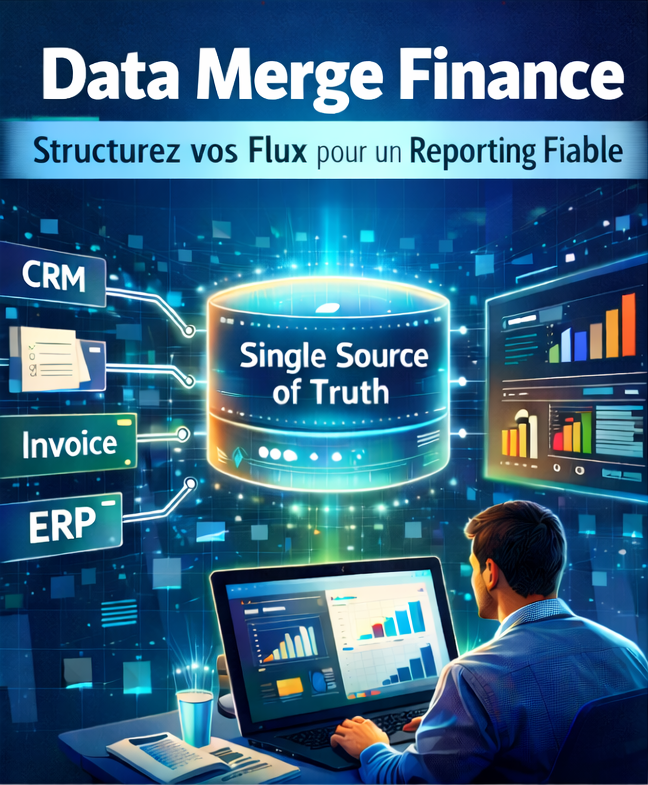
Financial reporting is reliable only if the data that feed are consistent, complete and well structured.
The real brake: fragmented data
CRM, billing, accounting and payment tools often produce partial visions. Without a clear structure, duplications and gaps are increasing.
Objective: One reliable source
- Synchronize systems
- Normalize data
- Making transformations traceable
Method for structuring flows
1. Mapping existing flows
Identify where the data is born and how it circulates.
2. Clean and standardize
Standardize formats and remove duplicates.
3. Automation of trade
Disseminate the data without rescission.
4. Centralize intelligently
Consolidate history and produce the right indicators.
Governance remains essential
Tools alone are not enough. There is also a need to clarify who manages the data, what controls apply and how changes are monitored.
Conclusion
Structure its financial flows is the foundation of reliable, useful and real-time reporting.
Field evidence
These items are based on accounting synchronization cases observed on Zoho Books environments, management software and accounting software Belgian or French. The examples below describe the operational logic used to frame a reliable flow.
Workflow type checked
- 1. Identify the source software: Zoho Books, Odoo, Teamleader or other billing tool.
- 2. Validate accounting objects: invoices, credit notes, third parties, VAT, newspapers and payments.
- 3. Define mapping rules: accounts, VAT codes, newspapers, reference formats and exceptions.
- 4. Test the stream on a real folder before progressive activation.
- 5. Supervise discards and correct the rules rather than reprocess exports by hand.

