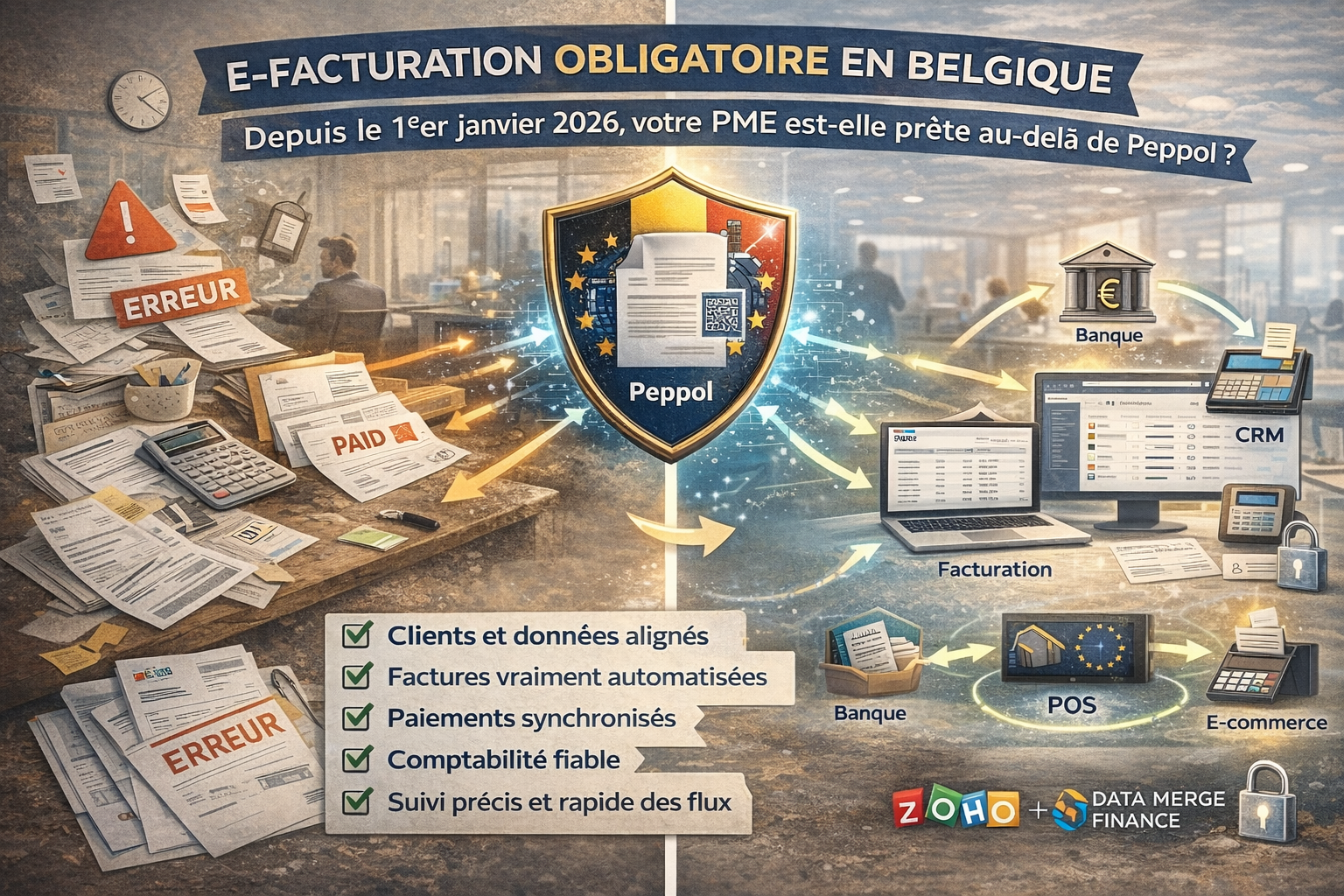
Since 1 January 2026, Belgian companies subject to VAT must exchange electronic invoices structured in B2B. But complying with Peppol is not enough to make the flows really fluid.
What the 2026 bond really changes
A PDF sent by e-mail is no longer sufficient in most of the Belgian B2B exchanges concerned. The invoice must be structured and run between systems, most often via Peppol.
This is a useful step, but it does not guarantee the consistency of customer data, VAT codes, assets, payments or accounting mappings alone.
In France, the regulatory trajectory follows a separate schedule. However, the bottom line message remains the same: compliance with the exchange channel is not enough if internal flows remain fragmented.
Why many SMEs remain in friction despite Peppol
- Reference customers and suppliers not aligned between tools
- Exceptions and assets still managed by hand
- Accounting records that always require corrections
- Payments disconnected from the rest of the cycle
- Closing still dependent on exports, emails and intermediate files
Being successful in 2026 is not just "having Peppol"
An SME is really ready when critical data circulates properly between its sales, billing, payment and accounting tools, without depending on a chain of manual corrections.
- Reference customers and suppliers
- VAT rules
- Invoices and assets
- Payment status
- Accounting maps and checkpoints
The role of Data Merge Finance
Data Merge Finance serves as an operational layer between your financial tools to prevent flow disruptions, reduce re-entry and make data more readable for the finance team.
Conclusion
Regulatory compliance allows you to enter the framework. Performance depends on the quality of your flow between your tools.
Field evidence
These items are based on accounting synchronization cases observed on Zoho Books environments, management software and accounting software Belgian or French. The examples below describe the operational logic used to frame a reliable flow.
Workflow type checked
- 1. Identify the source software: Zoho Books, Odoo, Teamleader or other billing tool.
- 2. Validate accounting objects: invoices, credit notes, third parties, VAT, newspapers and payments.
- 3. Define mapping rules: accounts, VAT codes, newspapers, reference formats and exceptions.
- 4. Test the stream on a real folder before progressive activation.
- 5. Supervise discards and correct the rules rather than reprocess exports by hand.

